
Enterprise Data Marketplace: The Practical Guide for 2026
Enterprise data marketplace explained for founders and marketing leaders. Learn the core components, business value, vendor selection criteria, and adoption
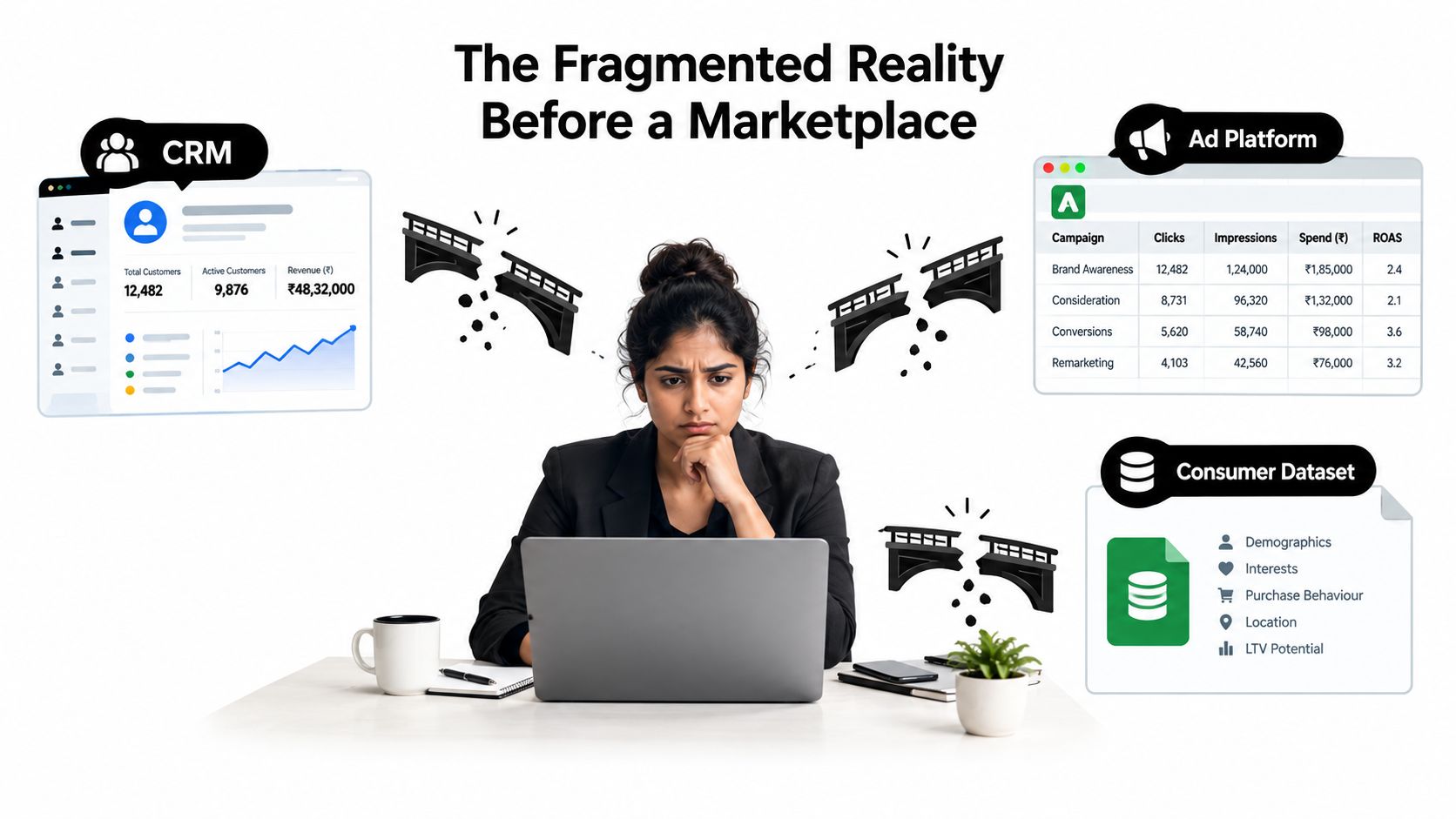
Your marketing lead has a campaign ready to launch, but the audience file sits in a spreadsheet, customer behaviour is trapped in an analytics tool, CRM records use different account names, and a purchased consumer dataset has unclear usage rights. Everyone has data. Nobody can confidently answer which version is current, who may use it, or whether it can be shared with a partner.
That situation is why the enterprise data marketplace has become more than a data catalogue. The useful version is a governed exchange layer where people and systems can discover, evaluate, access, combine, and sometimes buy data products under enforceable rules.
For founders, the important question isn’t whether a marketplace sounds advanced. It’s whether your company has enough repeated data demand, enough potential suppliers, or enough licensing complexity to justify one.
What an Enterprise Data Marketplace Actually Is
The marketing lead’s problem isn’t a lack of storage. The CRM export, advertising data, website events, and external audience file may all be available, yet the team still can’t turn them into a trusted decision. One file has an old customer identifier, another has no freshness date, and the third comes with a contract nobody in marketing has read.
A marketplace changes the operating model. Instead of treating data as an abandoned by-product of business systems, it treats a reusable dataset, dashboard, model, or API as a data product with an owner, description, quality information, access policy, and intended consumer. A buyer or internal user can then assess the product before requesting access.
India’s public-data experience shows why this distinction matters. By September 2017, the Open Government Data Platform had 118,450 datasets across more than 4,220 catalogues from 106 departments, with 12.57 million dataset views and 4.94 million downloads, according to India’s Press Information Bureau. The lesson isn’t that a startup should copy a government platform. It’s that discoverability, metadata, APIs, and governed access create the conditions for data reuse at scale.
A marketplace is not the same as a data lake
A data lake stores large volumes of raw or lightly processed data. It solves a storage and engineering problem. It doesn’t automatically tell a sales team what a field means, whether the data is current, or whether a partner may use it.
A data fabric is an architectural approach for connecting data across systems, often through metadata, integration, and governance. It can support a marketplace, but it isn’t itself a transaction model.
A data mesh distributes ownership to business domains and encourages teams to publish data as products. It can provide the organisational foundation for a marketplace, but a marketplace adds discovery, access workflows, commercial terms, and exchange controls.
The simplest analogy is a specialist market. A warehouse holds stock. A marketplace tells visitors what is available, who supplies it, what it costs, what conditions apply, and how the purchase is completed.
Founder test: If your proposed platform only lists tables and files, you’re building a catalogue. If it governs who can use which data, for what purpose, for how long, and under which commercial terms, you’re building an exchange layer.
Before investing, answer three questions:
- Who supplies the data? Internal teams, customers, partners, public agencies, or independent businesses?
- Who consumes it? Analysts, product teams, advertisers, lenders, AI developers, or external clients?
- What policy governs the exchange? Ownership, consent, permitted purpose, retention, quality, pricing, and revocation must be explicit.
If you can’t name both sides of the exchange, start with a governed internal catalogue or a small data-product pilot. A full marketplace becomes worthwhile when multiple parties repeatedly need trusted, controlled access.
The Five Building Blocks of a Marketplace
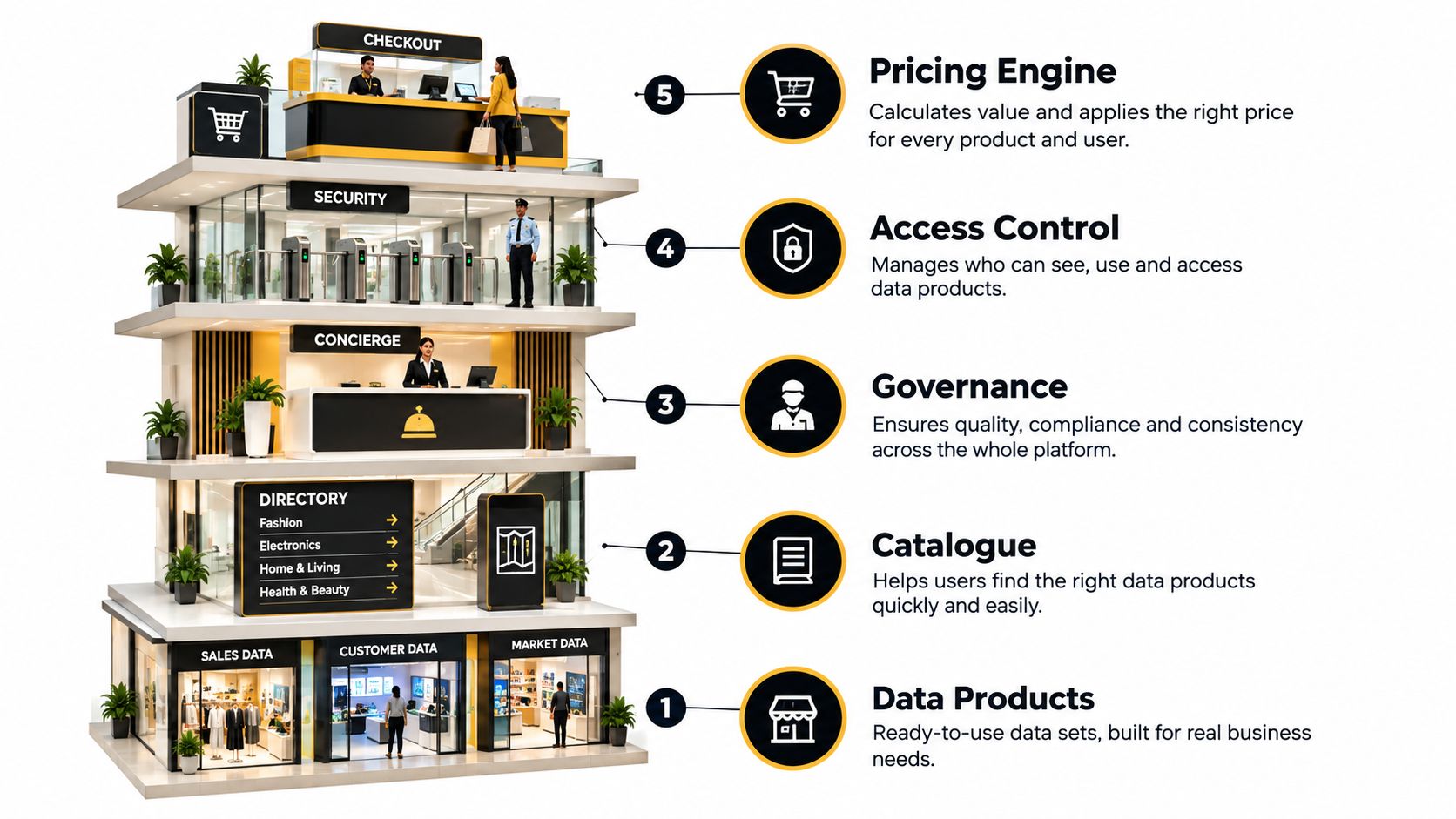
An enterprise data marketplace works like a shopping mall, but the products are datasets and the security desk enforces policy rather than checking a ticket. The analogy helps because each layer has a distinct job.
India’s National Data Sharing and Accessibility Policy, notified on 17 March 2012, established principles that still matter for private exchanges, including cataloguing, discoverability, standardised formats, API access, and governed sharing, as documented in the National Informatics Centre policy material.
1. Data products are the shops
A product isn’t just a database table with a clever name. It should solve a defined user problem and include enough information for someone to judge whether it fits.
A minimum product listing should expose:
- Business purpose: what decision or workflow the product supports.
- Schema and definitions: fields, formats, identifiers, and version history.
- Owner and contact: the person responsible for questions and changes.
- Freshness: the last update, expected update pattern, and known delays.
- Quality information: validation checks, missing-value notes, coverage, and limitations.
- Usage conditions: permitted users, purposes, regions, and onward-transfer rules.
The shortcut that causes trouble is publishing raw exports and expecting consumers to interpret them. That shifts the cost from the supplier to every buyer.
2. The catalogue is the directory board
The catalogue helps people find products without asking five teams for a spreadsheet. Search should work by subject, business use, owner, sensitivity, geography, freshness, quality tier, and access method.
A startup can begin with a searchable inventory and structured metadata. It doesn’t need to catalogue every asset on day one. The useful first release is a small set of products that have clear owners and real consumers.
The common failure is treating the catalogue as a static directory. A directory without usage data, stale-product alerts, approval status, and retirement rules becomes another abandoned list.
3. Governance is the building code
Governance determines whether a product may be used, by whom, and under which conditions. It should express purpose tags, consent status, retention limits, data classifications, geographic restrictions, and audit requirements in a form that systems can enforce.
The minimum viable version can be a policy register linked to each listing, with a human approval step for sensitive products. As transactions grow, those rules should become machine-readable so the platform can reject an unauthorised request instead of relying on memory.
4. Access control is the security desk
Access is not a single yes-or-no switch. A product may be available through an API, a controlled query, a secure data room, a file delivery, or a privacy-preserving environment.
A small team should start with scoped identities, approval workflows, expiring credentials, and access logs. Each request should record the user, product, purpose, time, and approved scope.
Don’t issue broad database access when the buyer only needs an aggregate result. Narrow access reduces exposure and makes later audits easier.
5. Monetisation is the checkout counter
External exchanges need commercial mechanics. These may include subscriptions, fixed licences, usage-based charges, royalties, partner terms, or free access for strategic users.
The minimum viable version is a product page with a price or quotation path, a licence template, an invoicing owner, and a record of usage. The shortcut to avoid is adding a price before defining what the buyer receives and what they may do with it.
A useful architecture reference is this startup cloud architecture guide, particularly when you’re deciding which capabilities belong in your application layer and which belong in managed infrastructure.
A whiteboard version should show five boxes: products, catalogue, governance, access, and commercial terms. If one box is missing, the platform may still support a useful internal data programme, but it won’t yet behave like a reliable marketplace.
Business Value and the Numbers Founders Care About
A marketplace earns a budget when it changes an economic outcome. The strongest business case usually combines revenue, avoided duplication, faster decisions, and lower exposure to uncontrolled sharing.
Revenue from data products
A consumer brand might package category-level demand signals for retail partners. A B2B software company might license deidentified operational patterns to an AI developer. In both cases, the commercial product isn’t “access to our database”. It’s a defined asset with a scope, quality description, licence, delivery method, and support expectation.
Track revenue per data product, renewal behaviour, buyer acquisition cost, and the cost of preparing each listing. If preparation and legal review consume more value than the licence can produce, the product isn’t ready for a marketplace.
Cost avoidance through reuse
Internal teams often buy similar enrichment, location, audience, or industry data separately. A marketplace can expose an approved internal product and prevent repeated procurement.
Build the case from invoices and procurement records, not optimistic assumptions. Compare the current cost of duplicate purchases with the cost of preparation, governance, support, and ongoing quality monitoring.
Indian enterprise investment in governance, integration, metadata management, and data quality is rising, partly because organisations need stronger foundations for AI and compliance, according to the UNCTAD material on India’s data ecosystem. That makes reuse a practical cost question, not just an architecture preference.
Faster time to insight
Analysts lose time locating files, clarifying definitions, requesting permissions, and reconciling different identifiers. A marketplace reduces that friction when listings contain usable documentation and access arrives through a predictable workflow.
Measure the time from a consumer’s request to their first valid query. Also record rejected requests, clarification cycles, and the proportion of products with an active owner. A faster search experience won’t help if the underlying product remains incomplete or stale.
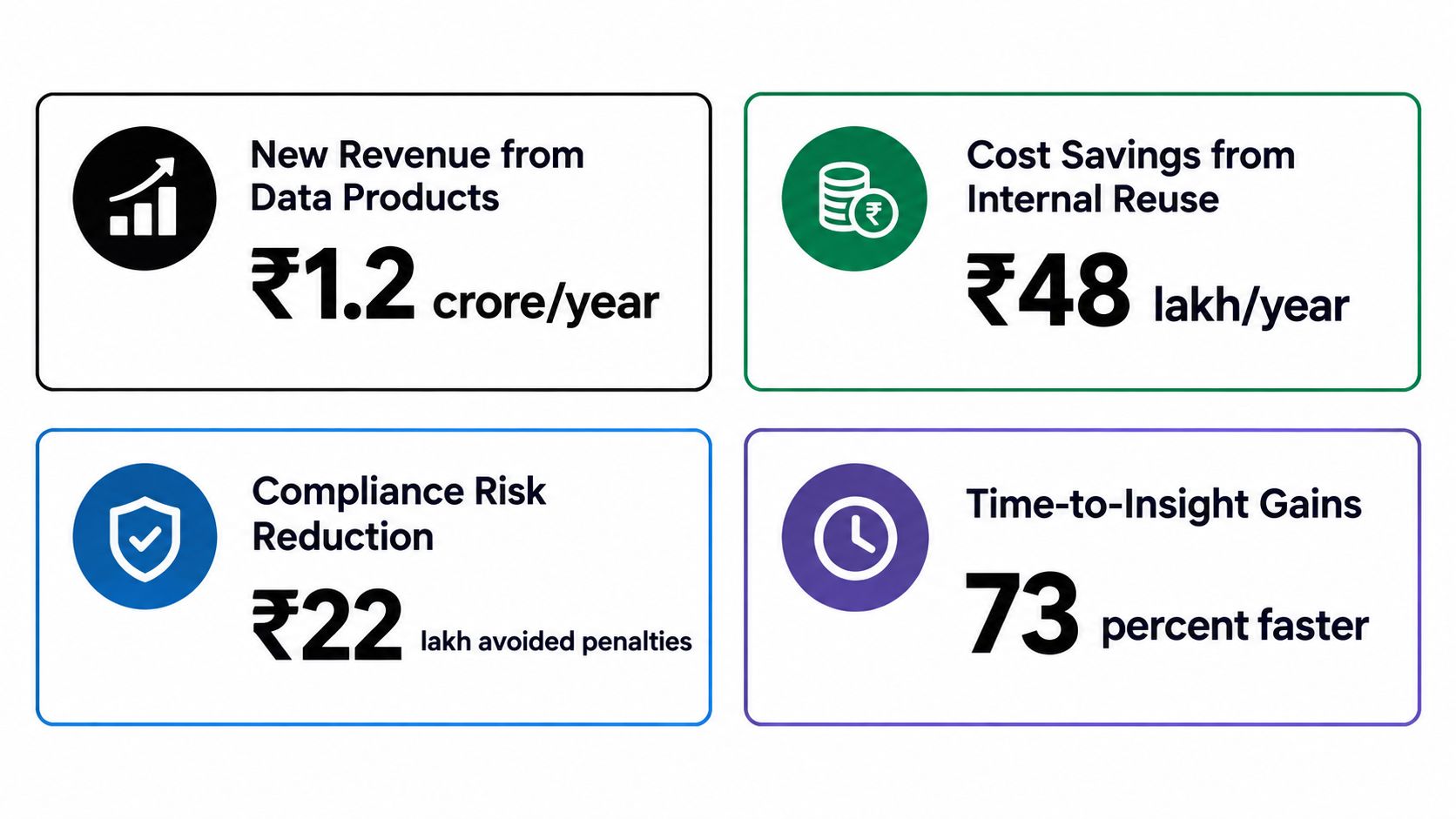
Reduced compliance exposure
Centralised access creates evidence. The business can show which product was requested, which purpose was approved, what was delivered, and whether access was revoked or expired.
That evidence may not appear as immediate revenue, but it matters when a customer, regulator, board member, or partner asks how the company handled personal or commercially sensitive information. Treat compliance as a risk-reduction line item with measurable indicators such as unresolved exceptions, products without provenance, and access grants outside policy.
Business-case rule: Put revenue and avoided procurement costs in the headline calculation. Put auditability and controlled sharing in the risk section, where their value is visible without pretending they are direct sales.
Use Cases That Stress Different Parts of the Stack
The right marketplace design depends on what crosses the boundary. A company sharing internal signals with its own teams has different needs from a supplier licensing records to external AI buyers.
Consumer intelligence for a brand
A consumer brand wants one intelligence layer across CRM records, advertising exports, website behaviour, and retail inputs. The immediate benefit is a more consistent view of audiences and campaigns, but the hard part is keeping definitions and freshness aligned.
This use case stresses the catalogue and access layer. Marketing users need to find current products, while sensitive records require narrowly scoped access. A campaign manager might need aggregated segments, not row-level customer history.
The make-or-break decision is whether the company defines a stable customer and campaign vocabulary before connecting every source. Without shared identifiers and clear ownership, the marketplace only makes inconsistent data easier to discover.
Enriched account signals for B2B software
A B2B SaaS company may combine its own product signals with permitted business information and offer account-level insights to customers. Buyers care about field definitions, update expectations, licence scope, and whether they can embed the result in their own workflows.
This pattern puts pressure on monetisation and partner onboarding. A product page needs a clear package, sample output, contract terms, support contact, and an access route that works for the buyer’s technical team.
The decisive choice is to define the licence before building the sales channel. If customers can download, resell, train models on, or combine the signals without clear restrictions, the company may create commercial and legal ambiguity that is expensive to unwind.
Supply-chain analytics for smaller businesses
A supply-chain startup might combine weather information, logistics events, shipment records, and customer-provided operational data. The resulting product could help businesses identify delays or plan inventory, but each source may have different ownership, reliability, and consent conditions.
This use case stresses governance and quality disclosure. One supplier may provide a stable API, another may send irregular files, and a third may restrict use to a particular customer or purpose. The marketplace must display those differences rather than presenting every source as equally dependable.
A practical quality classification can help:
- Exploratory: suitable for investigation, prototyping, and hypothesis generation.
- Decision-support: documented and monitored for business decisions, with known limitations.
- Production-grade: governed, versioned, monitored, and supported for operational use.
The critical decision is whether the platform exposes uncertainty clearly. A marketplace that labels every dataset “production-ready” will lose trust after the first stale or incomplete delivery.
How SourceX Can Help
Some founders don’t need to build a broad marketplace. They need a controlled route for licensing operational datasets to AI labs and other data buyers. SourceX addresses that narrower problem by coordinating fit assessment, inventory creation, rights review, deidentification, contracts, delivery, and payment.
Its useful distinction is supplier control. A company can create a private inventory from systems such as Salesforce, Zendesk, GitHub, Jira, SharePoint, and Google Workspace, while retaining approval over what is shown and what is ultimately released. SourceX records provenance, intended use, preparation steps, and the agreed scope before delivery.
That matters when the source data contains personal details, confidential business records, or unclear onward-use rights. A dataset can be technically valuable and still be unsuitable for licensing if the supplier can’t demonstrate lawful collection, ownership, permitted use, and appropriate privacy preparation.
The platform supports practical commercial decisions, including fixed-fee licensing, selection windows, exclusivity terms, invoicing schedules, and permanent licensing for selected data. Suppliers retain ownership of their original data, while the agreement sets out rights relating to prepared datasets and underlying intellectual property.
A founder should consider the SourceX enterprise data marketplace when the primary need is rights-cleared data licensing, not a self-service internal catalogue. It may be a better fit when the team lacks dedicated legal, privacy, and data-packaging capacity, or when buyers need structured operational records for model development.
It isn’t the right answer if your core problem is just finding internal dashboards or improving analytics ownership. In that case, build the internal product and governance foundation first. SourceX becomes relevant when external licensing, provenance evidence, deidentification, and buyer coordination are central to the business model.
A 90-Day Adoption Roadmap for Small Teams
A two-to-five-person data pod can test the marketplace concept without attempting an enterprise-wide transformation. The team needs a narrow scope, named owners, and an exit condition for each phase.
Days 1 to 30 build the foundation
Start with an inventory of the most requested datasets, not every asset in the business. Record the source system, owner, users, update pattern, sensitivity, current access method, known quality issues, and possible commercial restrictions.
Assign provisional product owners. Choose a minimum metadata standard that every listing must meet, then decide whether your first implementation belongs in an existing lakehouse, a SaaS marketplace product, or an open-source catalogue.
The phase is complete when the team can show a reviewed inventory, named owners, and a consistent listing template. Don’t move forward because the interface looks polished. Move forward because someone can answer what each product is, who may use it, and what happens when it changes.
Days 31 to 60 run a controlled pilot
Select three products with different characteristics, such as an internal operational dataset, a partner-supplied source, and an aggregated analytical product. Add access policies, quality tiers, request workflows, and usage logging.
Launch with one consumer team. Ask users to find a product without personal assistance, request access, understand the permitted purpose, and complete a real task. Measure time to first valid use, failed requests, documentation questions, and satisfaction.
For third-party sources, this guide to buying versus building integrations can help frame the trade-off between custom connectors and managed capabilities.
Days 61 to 90 scale the operating model
Add a partner-supplied product or a controlled external buyer. Introduce pricing only when ownership, rights, quality, and delivery are clear. Connect identity and consent systems where the pilot exposed repeated manual approval work.
A 2025 India SME Forum report surveyed 7,835 Indian MSMEs during 2024-25, highlighting why marketplace operators should expect uneven metadata, APIs, identifiers, and data quality among smaller suppliers, as described in the India SME Forum report.
The phase ends when one business unit or partner can use the marketplace without bespoke coordination from the data team. The most expensive sequencing mistake is launching monetisation before governance. A sale made without a clear purpose, licence, quality statement, or revocation path creates a support and compliance problem disguised as traction.
The Minimum Viable Data Contract
The catalogue tells a buyer what exists. The minimum viable data contract tells both sides what they are allowed to do with it.
This contract should travel with every product, whether the exchange is internal, partner-based, or commercial. It doesn’t need to be a long legal document at the start, but it must connect business intent to operational evidence.
Six clauses every transaction needs
| Clause | What it specifies | Evidence exchanged |
|---|---|---|
| Permitted purpose | The approved business or technical use | Purpose statement, approval record, use-case description |
| Provenance and lineage | Where the data came from and how it was transformed | Source-system record, lineage map, preparation log |
| Retention period | How long the recipient may hold or use the data | Expiry date, deletion requirement, retention policy |
| Consent and revocation | Whether consent applies and how access can be withdrawn | Consent status, consent artefact, revocation workflow |
| Geographic and onward-transfer restrictions | Where processing may occur and whether sharing may continue | Region rule, transfer restriction, sub-processor terms |
| Quality tier | The expected reliability and suitable decision context | Tier label, freshness date, coverage notes, quality checks |
These clauses solve different problems. Provenance answers “where did this come from?” Purpose answers “what may I do with it?” Retention answers “when must I stop?” Quality answers “how much should I trust it?”
A practical quality statement
Use the three-tier model consistently. Exploratory products support discovery but shouldn’t drive a critical operational decision. Decision-support products have documented limitations and monitoring appropriate to business analysis. Production-grade products have stronger ownership, versioning, quality checks, access controls, and change communication.
The tier isn’t a badge of prestige. It’s a warning label that helps a buyer choose the right use.
Designing during India’s transition window
India’s Digital Personal Data Protection Rules were issued in November 2025, while substantive provisions are scheduled to take effect in May 2027, according to Linklaters’ India data-protection update. That creates a transition period in which companies need to design catalogues, consent flows, retention policies, and audit trails before the final operating model has been fully tested.
The sensible response isn’t to wait. It’s to make the contract executable enough that a product owner, lawyer, privacy lead, and engineer can all see the same restrictions.
A contract should also define who is responsible for correcting quality failures, notifying consumers of schema changes, handling access requests, and approving onward transfers. If the answer lives only in email, the marketplace can’t enforce it.
For implementation teams, these API design best practices for startup APIs are useful when the contract must become part of request and delivery workflows rather than remain a document attached to a ticket.
Vendor Selection Criteria and KPIs
Vendor evaluations often become feature tours. A better approach is a scorecard with a one-to-five rating for each criterion and a disqualifier question that ends the conversation when the answer is unacceptable.
| Criterion | Score five means | Disqualifier question |
|---|---|---|
| Catalogue and metadata | Versioned schemas, ownership, freshness, lineage, and searchable business context | Can the platform show source, freshness, owner, and permitted use on every product? |
| Governance and consent | Purpose restrictions, consent records, retention, revocation, and audit evidence | Can policy block an unauthorised request rather than merely document it? |
| Access patterns | API, query, file, secure room, and controlled analytical delivery | Can consumers receive only the minimum scope they need? |
| Monetisation | Flexible licensing, subscription, usage, and metering options | Can the platform record what was delivered and under which commercial terms? |
| Deployment model | Cloud, self-hosted, or hybrid options aligned to sensitivity and operations | Does the deployment create a data-residency or supplier-dependency problem? |
| Integration effort | Working connectors, identity integration, and manageable operational ownership | Can your team support the integration without creating a second data platform? |
A vendor that scores well on discovery but can’t enforce purpose restrictions is not a safe exchange layer. A product with excellent governance but no workable delivery path may become a compliance archive rather than a useful marketplace.
Track these KPIs after launch:
- Active data products: products with a current owner, usable documentation, and recent validation.
- Consumer reach: teams, partners, or buyers using each product.
- Time to first dataset: elapsed time from request to valid consumption.
- Data-product satisfaction: whether consumers can find, understand, and use the product.
- Revenue or cost avoidance per product: the economic result tied to each listing.
- Compliance exceptions: open policy breaches, unresolved approvals, or missing evidence.
The scorecard helps you choose a tool. The KPIs tell you whether the choice created a working exchange.
Common Pitfalls and the Early Warning Signals
The first failure is building a beautiful catalogue with no transaction path. The warning signal is that users browse listings but make no external requests, run no approved queries, and never reach a buyer or supplier workflow. Within a week, add one real product request, one approval route, and one delivery method.
The second failure is designing perfect metadata before publishing anything useful. If the team spends its time debating every possible field while product owners can’t release a single usable dataset, momentum has already stalled. Publish a small, clearly labelled pilot product and improve the template from consumer questions.
The third failure is presenting every dataset as production-ready. One buyer finding stale, incomplete, or poorly documented data can damage confidence across the catalogue. Add quality tiers, freshness dates, known limitations, and a visible owner before expanding the inventory.
India’s Account Aggregator rails offer a useful model for consent-based exchange. They allow customers to authorise data sharing without transferring ownership of the underlying records, as discussed in this analysis of India’s data-exchange model. The broader lesson is that consent artefacts and interoperable interfaces are operational components, not decorative compliance features.
Five habits separate durable marketplaces from stalled catalogues:
- Name owners: Every product has someone accountable for meaning, quality, and change.
- Show restrictions: Purpose, retention, consent, and onward transfer appear before access.
- Label quality accurately: Buyers can distinguish exploratory from production-grade data.
- Measure use: The team tracks requests, successful consumption, value, and exceptions.
- Start with a transaction: The marketplace proves that a supplier and consumer can complete a controlled exchange.
A founder doesn’t need a massive platform to begin. Start with a few valuable products, a policy that travels with each one, and a buyer or internal consumer willing to test the workflow.
If your team is struggling with fragmented customer data, unclear ownership, or an uncertain route from analytics to revenue, Startupbricks can help you turn the marketplace idea into a practical SEO, AI, and growth plan. Contact the team with your current data sources, target consumers, and one exchange you want to make possible, then use that conversation to decide whether you need a catalogue, a governed internal platform, or a true enterprise data marketplace.
Calculate your exact project timeline & budget
Configure your MVP tech stack, team scope, and marketing channels for an instant 2026 cost breakdown in 30 seconds.