
10 Examples of Digital Products to Sell in 2026
Explore 10 examples of digital products startups can launch in 2026, from SaaS and courses to AI tools, with monetization models and go-to-market tips.
A digital product can be sold the moment it works, with no factory, no inventory, and no shipping delay. That speed is the attraction. The hard part is choosing a format that matches the buyer, the payment habit, and the amount of building and support your team can sustain.
The ten examples below cover direct offers, software, education, templates, media, creative assets, AI products, and free tools that generate demand. Each one is judged through three operator questions: who pays, how do they pay, and how do they find you? You’ll also get one practical go-to-market move for every category, plus the situations where the model works and where it tends to disappoint.
For India-focused founders, format choice matters even more than another generic product list suggests. Government data reports 460 million UPI users and 65 million merchants, while nearly half of digital payments are classified as small or micropayments, creating a strong case for mobile-first, low-friction products such as regional-language kits, paid calculators, and micro-subscriptions (official government document). The winning product isn’t always the most advanced one. It’s the one buyers can understand, trust, pay for, and use quickly.
1. AmaJova
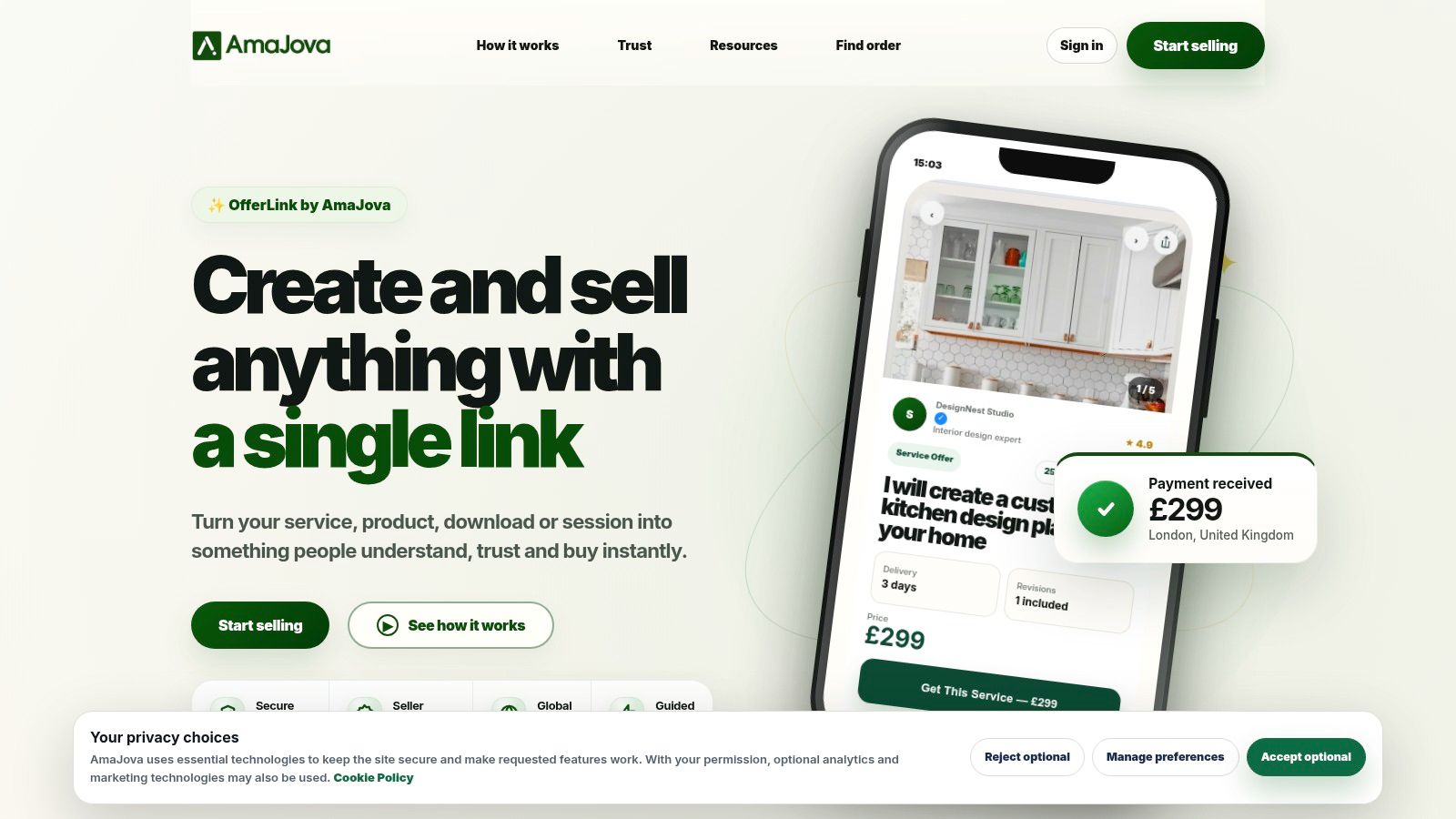
AmaJova is a strong fit when you have something valuable to sell but don’t need, or don’t want, a full ecommerce site. Its core unit is the OfferLink, a professional page for a service, physical product, digital download, or live session. The page brings the offer definition, inclusions, price, fulfilment details, FAQs, expectations, and checkout into one buyer-facing flow.
That solves a common problem with early digital products. Founders often promote through social profiles or messages, then manage payment, delivery, questions, and disputes in separate places. Buyers have to reconstruct what they’re purchasing. AmaJova connects the order record with messages, access or delivery steps, payment status, dispute information, and completion tracking. Secure checkout, seller verification, protection resources, and an optional Buyer Service Fee disclosure help make the transaction clearer before payment.
Monetization and operating fit
The model is transaction-led rather than a traditional subscription storefront. Sellers publish individual offers and receive payouts after the platform’s clearance process, with support for 150+ currencies and progression through a Seller Growth Program. That makes the platform useful for consultants, creators, coaches, designers, and small teams testing several offer types without committing to custom commerce development.
The trade-off is control. A dedicated website gives you more freedom over branding, analytics, checkout logic, and customer data. AmaJova is better when speed, trust signals, and a structured buyer journey matter more than owning every layer of the stack.
Practical rule: Use one OfferLink when your immediate bottleneck is offer clarity, not website capability.
The target buyer is someone ready to pay for a defined outcome, download, appointment, or session. Find those buyers through a bio link, direct outreach, campaign landing page, existing website, or community post. This week, publish one narrow OfferLink with explicit inclusions, delivery timing, boundaries, and one optional extra. Send it to ten people who already ask for that solution. Track completed orders and buyer questions, not clicks alone. You can review the platform’s digital product examples before choosing your first format.
2. Software as a Service
SaaS turns software into an ongoing service. Customers access a cloud-hosted product through a browser or app, while the vendor handles updates, hosting, security, and maintenance. Common monetization models include per-seat subscriptions, tiered plans, usage-based billing, and free trials.
The attraction is recurring revenue and continuous product feedback. The cost is that every customer creates an ongoing obligation. Weak onboarding, poor reliability, or missing features can increase churn before the product has recovered its acquisition cost. A narrow workflow usually beats a broad platform at launch because the buyer can recognize the job it completes.
Monetization and acquisition
The target buyer might be a marketing manager who needs reporting automation, a founder who needs a niche dashboard, or an operations team replacing spreadsheets. They pay monthly or annually when the product saves time, reduces errors, or makes a recurring decision easier.
Build effort is high. You need product design, engineering, infrastructure, support, analytics, and security practices. Startupbricks naturally fits this category through SEO, performance marketing, web apps, APIs, custom dashboards, and AI SaaS development. For trial design, the SaaS free trial guide is a useful internal reference.
Don’t launch with a long feature list. Launch around one repeated job, instrument activation, and speak to users before adding adjacent workflows. Find buyers through problem-led SEO, targeted outbound, integration partnerships, and product-led referrals.
This week, interview a small group of potential users and ask them to complete the workflow using a clickable prototype or manual service. Measure whether they reach the promised outcome. If they won’t use the manual version, building the software won’t fix the demand problem.
3. Ebooks and Lead Magnets
An ebook is a downloadable guide, usually delivered as a PDF or reader-friendly file. For most businesses, its strongest role isn’t direct revenue. It’s a lead magnet that exchanges useful knowledge for an email address and gives the company permission to continue the conversation.
This model suits buyers who need orientation before they commit to a service, course, software product, or consultation. A founder can publish a practical guide for a narrow business problem. A marketing manager can use it to support an SEO topic cluster, sales enablement sequence, or campaign landing page.
Monetization and distribution
The monetization model is usually indirect. The ebook generates qualified leads, then email, sales calls, demos, or a paid product create revenue. You can also sell a focused guide directly, but buyers won’t pay for information they can find elsewhere unless the document organizes decisions, examples, tools, or implementation steps unusually well.
Build effort is low to moderate. Research, writing, editing, layout, forms, delivery, and promotion still require discipline. Thin or generic content damages trust, while a strong guide can be repurposed into articles, webinars, emails, and social posts.
Use SEO to capture informational searches, then connect the guide to a clear next step. This week, take one repeated sales question and turn it into a narrow guide with a checklist and a practical example. Publish a landing page, add one follow-up email, and measure qualified leads rather than download volume.
4. Online Courses
Online courses package expertise into a structured learning experience. The format can include video, written lessons, exercises, quizzes, downloads, community support, live sessions, or a blend of these. Buyers pay for a transformation, not for a folder full of recordings.
The target buyer is a learner who wants a guided path and enough confidence to complete a task. Self-paced courses suit people who value flexibility. Cohort or live formats suit buyers who need accountability, feedback, and deadlines. The latter requires more delivery work, but it can create a stronger experience than a passive content library.
Where courses work and fail
The monetization model is commonly a one-time purchase, payment plan, cohort fee, or ongoing membership. Build effort is high because the curriculum must be designed, recorded, edited, hosted, supported, and updated. Marketing effort is also substantial. A course needs a credible promise, proof of expertise, and a distribution channel.
Completion is the operational risk. More lessons don’t necessarily create more value. A short course with assignments and feedback can outperform a large library if learners know exactly what to do next.
This week, don’t record the full curriculum. Sell or invite a small pilot around one outcome, deliver it live, collect learner questions, and use those questions to shape the final modules. Track completion of the core outcome, not merely lesson views.
5. Digital Templates
Templates are ready-made structures that buyers duplicate and customize. They include Notion workspaces, Google Sheets models, Excel financial models, pitch decks, Figma files, Canva designs, document packs, and operating checklists.
The buyer pays to avoid starting from a blank page. Founders want planning and finance systems. Marketing managers want campaign calendars, reporting dashboards, content briefs, and brand documents. The product works when the template includes useful logic, sensible defaults, clear instructions, and a visible connection to a recurring job.
Monetization and go-to-market
Templates are usually sold individually, in bundles, or through a library subscription. Build effort is low to moderate, but support can become the hidden cost. Buyers may not understand formulas, permissions, databases, or customization. Platform changes can also break functionality.
Marketplace distribution can provide discovery, but it also creates price pressure and copycat risk. Direct distribution gives you more control over positioning and the customer relationship. Differentiate through a specific use case, strong documentation, updates, and a short walkthrough.
This week, choose one workflow you already use repeatedly. Remove every unnecessary field, add an example with fictional data, record a brief setup walkthrough, and sell it to a narrow audience. Ask the first buyers where they get stuck, then update the template before creating a bundle.
6. WordPress Themes and Plugins
WordPress themes control presentation. Plugins add functions such as forms, SEO workflows, ecommerce, analytics, memberships, or integrations. Developers sell them through marketplaces or directly, often with licenses that include updates and support.
The target buyer is a site owner, freelancer, agency, or marketing team that needs a capability without commissioning a custom build. Monetization may combine a free core product with paid extensions, or an annual license that includes updates and support. A focused plugin can win when it solves one annoying compatibility or workflow problem better than a general alternative.
The support burden is real
Build effort is moderate to high. You need compatibility testing, documentation, version management, security controls, support processes, and a plan for changes in the WordPress ecosystem. Hosting environments vary widely, so a bug that doesn’t appear in your test setup may still become a customer issue.
The advantage is distribution. WordPress users already understand the installation model, and useful products can support the vendor’s SEO and brand visibility. The disadvantage is intense competition and a support queue filled with questions outside the product’s intended scope.
This week, review support requests or public complaints in one narrow WordPress category. Build a small extension that addresses a repeated problem, document supported configurations clearly, and recruit a few testers before listing it publicly. Measure activation and retained usage, not downloads alone.
7. Mobile Apps
Mobile apps sit on the buyer’s home screen and can use device capabilities such as notifications, location, camera, or health data. That access creates opportunities for utility, education, productivity, entertainment, and recurring services. It also creates a demanding maintenance cycle across operating systems, devices, app-store rules, and payment systems.
The target buyer pays through a freemium upgrade, in-app purchase, subscription, or sometimes a one-time purchase. The best candidates have a repeat-use behavior. A utility that customers need once may work better as a web tool or direct purchase than as an app requiring installation and updates.
Build effort and retention
Build effort is high, especially if you support native iOS and Android experiences. Cross-platform development can reduce duplication, but it doesn’t eliminate testing, performance work, store review, analytics, accessibility, or customer support. Acquisition is another challenge because app-store presence doesn’t guarantee discovery.
Find buyers through search-optimized store listings, creator partnerships, communities, content, referrals, and a clear onboarding promise. Push notifications should support useful actions, not compensate for weak retention.
This week, test the core behavior with a mobile-friendly web prototype. Ask users to complete the target task repeatedly and record where they stop. Only move to a full app build if the behavior creates a reason to return.
8. AI Tools, Custom GPTs, and AI Agents
AI products range from task-specific assistants and custom GPTs to workflow automations, recommendation engines, data-extraction systems, and agents connected to business software. The format is attractive because a focused prototype can be built faster than traditional software, but speed makes weak differentiation easier to expose.
The target buyer pays for a result such as faster research, cleaner data, better support responses, or automated internal work. Monetization can be subscription-based, usage-based, API-based, or bundled into a broader service. A prompt alone is rarely a durable product. The defensible layer usually comes from workflow design, proprietary context, integrations, evaluation, and a reliable user experience.
Reliability determines the product
Build effort ranges from low for a narrow assistant to high for a production agent handling sensitive workflows. Third-party model dependence creates cost, availability, and behavior risks. Accuracy, privacy, permissions, auditability, and human review need explicit treatment.
Startupbricks’ AI work naturally fits this category, including AI writing and content tools, intelligent search and discovery, recommendation engines, automated data extraction, chatbots, and automation workflows. Teams exploring connected AI systems can use this MCP guide as an internal technical reference.
This week, choose one workflow where a human already reviews every output. Build a narrow assistant, create a test set from real tasks with sensitive information removed, and record accuracy, edit time, and escalation rate. Don’t market general intelligence. Sell the measurable job the system completes.
9. Digital Newsletters and Paid Subscriptions
A newsletter is a recurring publication delivered by email and often mirrored on the web. A paid version may provide analysis, research, commentary, a private archive, community access, or practical recommendations. The model is attractive because the creator builds a direct audience instead of relying entirely on social distribution.
The target buyer is a reader with a recurring information need. Niche analysis often beats broad commentary because subscribers can explain why the publication belongs in their working routine. Free and paid tiers can work together, but the free tier needs to demonstrate the quality and point of view of the paid product.
Retention is the business
Monetization usually combines subscriptions with sponsorships, partnerships, or affiliate revenue. Build effort is low to moderate, but publishing consistency and editorial judgment are demanding. Churn remains a constant concern because subscribers reassess recurring payments.
Find readers through search-friendly archives, social excerpts, guest appearances, referrals, communities, and a strong free edition. Avoid promising volume when the actual value is decision support. A concise issue that changes what the reader does can be more valuable than a long digest.
This week, define one audience and one recurring decision they make. Publish a free issue that solves part of that decision, then invite readers to a paid pilot with a specific additional benefit. Track replies, qualified signups, and renewal intent, not just list growth.
10. Stock Digital Assets and Design Libraries
Stock digital assets include photographs, illustrations, icons, fonts, video clips, UI kits, Figma files, and brand asset packs. Buyers pay for licensed access to files they can use in campaigns, products, presentations, websites, or internal systems.
The target buyer is a designer, marketer, agency, content team, or product group under time pressure. Monetization can be a one-time asset sale, standard and extended licenses, bundles, or subscription access to a library. The strongest products solve a recognizable visual need for a defined industry instead of adding another undifferentiated collection.
Licensing and discoverability
Build effort varies by asset type. Production may be substantial, while delivery is cheap. The ongoing work involves tagging, previews, metadata, licensing terms, updates, customer support, and protection against misuse. Marketplaces offer discovery but take control over presentation, pricing, and customer relationships.
Generative AI is increasing pressure on generic stock content. Specificity, consistent style, commercial clarity, and useful curation give a library a better chance of standing out. Brands can also build internal libraries that reduce repeated production work across teams and partners.
This week, package a small collection around one campaign need, write plain-language license terms, and publish landing pages for the exact searches your buyer uses. Contact designers or marketers in that niche with a preview set and ask which assets they would use.
11. Free Interactive Tools and Calculators
Free interactive tools turn a visitor’s inputs into a personalized result. Examples include SEO audit checkers, ROI calculators, pricing estimators, website graders, keyword tools, and assessment utilities. They generate value immediately, which makes them more persuasive than a static sales page when the buyer has a measurable problem.
The target buyer is someone actively looking for an answer. A free tool can monetize indirectly through qualified leads, consultations, software upgrades, or a detailed report. The user may provide an email address for deeper results, but the tool needs to be useful before the gate. Otherwise, it feels like a form disguised as a product.
SEO, product proof, and conversion
Build effort is moderate to high. You need reliable logic, a clear interface, data maintenance, technical performance, reporting, privacy controls, and a plan for handling edge cases. Accuracy matters because an incorrect result can damage trust and create poor sales conversations.
This category fits Startupbricks’ SEO, performance marketing, brand, and product capabilities particularly well. The company’s calculator shows the basic principle, a focused utility can attract intent while demonstrating how a more complete service or platform works.
This week, identify one search query that signals a real buying problem. Build the smallest useful calculator, explain the methodology, show a sample result, and connect the output to one relevant next step. Measure completed uses, qualified leads, and downstream sales conversations.
11-Item Digital Product Comparison
| Product / Category | 🔄 Implementation complexity | ⚡ Resource requirements | ⭐ Expected outcomes | 📊 Ideal use cases | 💡 Key advantages / tips |
|---|---|---|---|---|---|
| AmaJova | 🔄 Low, guided OfferLink setup, minimal dev | ⚡ Low technical overhead; content, verification, payment fees | ⭐ Clear offers, unified order records, higher buyer confidence | 📊 Individual sellers, service providers, cross-border micro‑sales | 💡 Use OfferLink for bios/campaigns; leverage seller growth program, https://amajova.com/resources/digital-product-examples |
| Software as a Service (SaaS) | 🔄 High, ongoing platform, multi‑tenant ops | ⚡ Significant engineering, infra, support, marketing | ⭐ Predictable MRR and scalable margins | 📊 B2B tools, collaboration, CRM, subscription products | 💡 Validate demand; use freemium/trials; track MRR, churn, CAC, LTV |
| Ebooks & Lead Magnets | 🔄 Low, content creation and design | ⚡ Low production cost; promotion budget required | ⭐ Strong lead capture and topical authority | 📊 Top‑of‑funnel education, SEO lead generation | 💡 Focus a single problem; short form gate and rapid nurture |
| Online Courses | 🔄 Medium‑High, course design, platform integration | ⚡ High upfront time, video production, community facilitation | ⭐ Scalable revenue and expert positioning | 📊 Skill training, cohort programs, premium education | 💡 Pre‑sell/beta; short lessons; add cohorts/accountability |
| Digital Templates | 🔄 Low, design templates and documentation | ⚡ Low build cost; maintenance for platform changes; marketplace fees | ⭐ Repeatable sales; time‑saving value for buyers | 📊 Founders, marketers, rapid project starts (Dashboards, decks) | 💡 Solve narrow high‑intent problems; include demos; bundle |
| WordPress Themes & Plugins | 🔄 Medium, compatibility, updates, support demands | ⚡ Dev time plus ongoing testing/support; marketplace distribution | ⭐ Recurring license revenue and wide reach | 📊 Small businesses, niche site functionality, SEO tooling | 💡 Offer free core for distribution; focus on niche; document setup |
| Mobile Apps (Freemium/Subscription) | 🔄 High, native/cross‑platform, store compliance | ⚡ Significant dev, UX, marketing; app‑store fees | ⭐ High engagement and multiple monetization routes | 📊 Consumer utility, habit‑forming, health/entertainment apps | 💡 Prioritise onboarding and ASO; monitor day‑1/7/30 retention |
| AI Tools / Custom GPTs | 🔄 Medium, prompt engineering, model integration | ⚡ Moderate dev; ongoing API costs and evaluation effort | ⭐ Quick MVP launches; measurable automation/time savings | 📊 Workflow automation, specialised assistants, content tools | 💡 Solve a narrow workflow; track cost per query; publish data handling |
| Digital Newsletters (Paid) | 🔄 Low‑Medium, content cadence and subscriber ops | ⚡ Low production cost; time for consistent delivery and growth | ⭐ Owned audience, subscriptions, sponsorship revenue | 📊 Niche thought leadership, lead nurturing, community building | 💡 Launch free tier first; publish archives; track open→paid conversion |
| Stock Digital Assets & Libraries | 🔄 Low‑Medium, asset creation and licensing setup | ⚡ Time to create catalog; marketplace fees; tagging/refresh work | ⭐ Scalable passive income; subscription library revenue | 📊 Designers, agencies, brands needing reusable assets | 💡 Niche visual style; maintain metadata and refresh regularly |
| Free Interactive Tools & Calculators | 🔄 Medium‑High, dev, accuracy, maintenance | ⚡ Dev + data upkeep + SEO/promotion investment | ⭐ High‑intent leads, backlinks, strong SEO value | 📊 Lead generation for service businesses; top‑of‑funnel acquisition | 💡 Make free output shareable; gate detailed reports; measure tool→lead conversion |
Choose One Digital Product Model and Test It This Quarter
The right digital product model depends on who pays, how they prefer to pay, and how much build effort your team can sustain. A founder with a small audience and strong expertise may be better served by an OfferLink, template, focused guide, or live course than by a subscription app. A marketing manager with reliable search demand may get more value from an interactive tool that qualifies leads. A technical team with a repeated workflow and clear retention signal can justify SaaS or an AI product.
Don’t choose based on perceived prestige. Software isn’t automatically better than a template, and a course isn’t automatically more valuable than a calculator. Choose the format that delivers the buyer’s desired outcome with the fewest unnecessary steps.
Start with three decisions:
- Name the paying buyer: Write down the role, urgent problem, current workaround, and reason they would pay now.
- Choose the payment model: Decide whether the first version needs a one-time transaction, recurring subscription, usage-based fee, or lead-generation path.
- Set the build boundary: Define what you’ll deliver manually, what must be automated, and what you won’t build until demand is proven.
Then define the single metric that proves demand. For SaaS, it may be trial-to-paid conversion or repeated use of the core workflow. For an ebook, it may be qualified lead volume. For a course, it may be completion of the promised outcome. For a template, it may be paid conversions and support requests that reveal whether buyers can implement it. For a calculator, it may be completed assessments that become qualified conversations.
Launch a small version before investing in full production. Sell a narrow offer, run a pilot, publish a lightweight tool, or manually deliver the workflow behind an AI product. Collect objections and observe behavior. Buyers will tell you more through incomplete checkouts, repeated questions, and abandoned workflows than through enthusiastic opinions.
Once the signal is clear, improve the product and its distribution together. Startupbricks can support the work behind that launch through brand strategy, SEO, performance marketing, web and mobile development, dashboards, APIs, and AI product development. Start with one buyer, one problem, one metric, and one version you can ship this week.
Calculate your exact project timeline & budget
Configure your MVP tech stack, team scope, and marketing channels for an instant 2026 cost breakdown in 30 seconds.