
7 Data Monetization Strategies for Startups in 2026
Discover 7 data monetization strategies for startups, from benchmark reports to usage-based pricing, with steps, pricing, and compliance tips.
Your data can earn money long before you have scale. India’s data-monetization market was estimated at US$3.411 billion in 2020 and is projected to reach US$5.725 billion by 2027, according to India’s telecom regulator. That opportunity doesn’t mean a startup should become a data broker. It means useful operational records, product signals, campaign results, and market patterns can become insights, services, features, or licensed outputs.
Most startups sit on valuable data and never turn it into revenue because they assume monetization requires enterprise infrastructure. It doesn’t. This guide ranks seven practical data monetization strategies by how realistically an early-stage startup can begin, from relationship-led models to technically demanding platforms. Each model includes the problem it solves, a sensible first implementation, pricing logic, and the privacy risk you need to manage.
The ranking deliberately leaves out enterprise-only plays such as selling raw personal data and building retail media networks. Those models require scale, governance, distribution, and legal capacity that most founders don’t have at the start.
1. SourceX
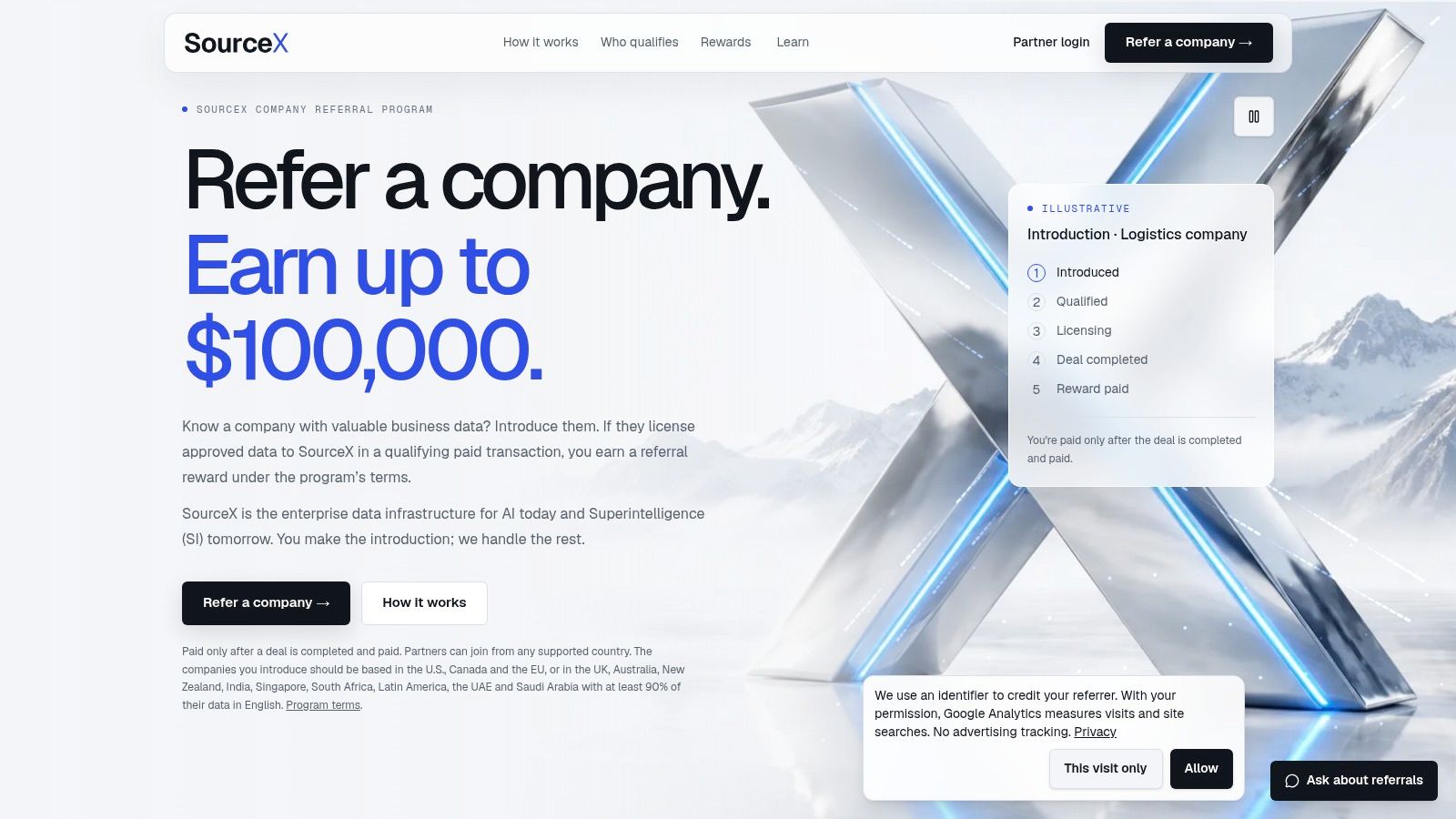
SourceX is the most accessible option when your strongest asset isn’t a data platform, but a network of companies holding valuable business records. The model is referral-led. You introduce a suitable company to SourceX, and SourceX manages qualification, rights review, pricing, contracting, data preparation, delivery, and payment.
The licensed records can include support tickets, emails, documents, chat, and system records used for AI training and evaluation. That makes the model relevant to advisors, consultants, operators, agencies, and well-connected professionals who know companies with substantial knowledge-work data but don’t want to build a licensing operation themselves.
What problem SourceX solves
Selling or licensing business data involves more than finding a buyer. A company must establish what it owns, confirm that it has the right to share it, remove or manage restricted information, negotiate terms, prepare the data, and coordinate delivery. Most startups and professional networks aren’t equipped to handle that workflow.
SourceX acts as the direct licensing partner for the referred company. The referrer makes the introduction, while SourceX handles the commercial and operational process. Initial exploration can use no-upload tools, so a company can outline its data scope without immediately transferring operational records.
The referral economics are unusually concrete. Partners can earn 25% of the Actual Supplier Payout, with rewards capped at $100,000 cumulatively per referred company, subject to the program’s terms and approval. A qualifying supplier payout of $400,000 would therefore produce a $100,000 referral reward, before any applicable conditions.
Who should consider it
The strongest introductions are knowledge-work companies with 50 or more full-time employees at peak, a documented operating history, and substantial business records. The opportunity is available across the U.S., Canada, the EU, the UK, Australia, New Zealand, India, Singapore, South Africa, Latin America, the UAE, and Saudi Arabia. Outside the U.S., Canada, and the EU, at least 90% of the data must be in English.
Partners can submit companies through a personal referral link or dashboard. The program includes a 90-day attribution window, referral-status stages such as Estimated, Eligible, Approved, and Paid, and tools for checking company fit, building an introduction email, finding network opportunities, and creating a data inventory.
Practical rule: Introduce the decision-maker who understands both the company’s records and its rights to use them. A generic contact is less useful than a trusted connection to an owner, executive, legal lead, or data decision-maker.
The privacy risk is still real. A referral doesn’t transfer rights, and an introduction doesn’t guarantee acceptance, a licensing deal, or payment. The referred company must pass SourceX’s review, and rewards become eligible only after buyer acceptance, cleared buyer payment, SourceX paying the company, and finance approval.
This model is right when you have access to suitable companies but don’t want to build licensing infrastructure. It’s not right if you’re trying to monetize your own startup’s data immediately, have no qualified business relationships, or expect payment for submitting a lead. Explore the SourceX referral program before making an introduction, and treat the opportunity as a qualified commercial referral rather than passive income.
2. Data-Driven Consulting and Managed Services
The safest starting point for many startups is to sell what you can do with data, not the data itself. A consultancy can analyze a client’s marketing performance, build dashboards, improve attribution, identify conversion bottlenecks, forecast demand, or manage ongoing optimization. The client keeps control of the underlying records, while your team earns for expertise and execution.
This distinction matters. A startup may have strong analytical skills but lack enough proprietary data to create a standalone product. Consulting lets you monetize methodology, judgment, and implementation before investing in a data marketplace or API.
Where the model works
Agencies and specialist operators can package services around a clear business outcome. Examples include SEO diagnostics, paid-media optimization, conversion testing, customer segmentation, lead scoring, or executive reporting. A dashboard by itself is rarely a durable offer. A dashboard that tells a marketing manager which campaigns to pause, which audiences to prioritize, and which landing pages need attention is more valuable.
Pricing can combine several structures:
- Project fees: Charge for a defined audit, dashboard build, measurement setup, or forecasting engagement.
- Retainers: Provide recurring analysis, reporting, and optimization with agreed deliverables.
- Performance-linked fees: Tie part of the fee to a measurable outcome only when attribution and client-controlled variables are clear.
A productized service improves margins. Instead of rebuilding every dashboard from scratch, define a repeatable data intake, reporting template, review cadence, and action plan. The trade-off is that customization decreases as repeatability increases.
Main trade-offs
The privacy risk is comparatively low because the client owns or controls the raw data. You still need access controls, retention rules, and clear contractual limits. Don’t download customer records to personal devices or reuse one client’s benchmarks in another client’s work without explicit permission.
The main commercial weakness is scalability. Revenue often follows headcount unless you standardize delivery, add software, or train clients to use self-service tools. Results also depend on factors outside your control, including budget, creative quality, sales execution, and product-market fit.
A strong services layer can combine SEO, performance marketing, and technical implementation through Startupbricks tech consulting services. The right test is simple: can you deliver the same decision-support workflow for several clients without multiplying effort at the same rate?
3. Aggregated Insights and Benchmark Reports
Aggregated insights become monetizable when they help a defined buyer make a better decision. Package patterns across a sufficiently broad dataset into benchmarks, trend reports, industry indices, or dashboards. Keep customer-level records out of the product.
The work sits in selection, cleaning, aggregation, interpretation, and presentation. A retailer may want to compare category conversion patterns with broader market behavior. A marketing team may pay for benchmarks covering channel efficiency, content performance, or audience trends in its sector. The buyer pays for a clearer reference point and a practical decision, while you carry the cost of producing and maintaining it.
Start with a narrow question. “Industry trends” gives an editorial team little direction. “Quarterly acquisition benchmarks for independent education businesses” defines the audience, dataset, update cycle, and likely use case.
Choose the format according to the buying moment:
- Annual reports: Build authority, support lead generation, and give sales teams useful evidence.
- Recurring dashboards: Serve customers monitoring changes over time.
- Benchmark subscriptions: Let users compare their results with a defined peer group.
- Gated research: Generate qualified demand when direct report revenue is not the first objective.
One dataset can support several offers. Publish a public summary for awareness and backlinks, then reserve deeper analysis for a paid report or sales tool. Track the path from download to qualified conversation or purchase. A large audience has limited value if it contains few buyers or does not lead reliably to paid products.
Privacy review belongs in product development, not at the end. Aggregation reduces exposure, yet small or narrow cohorts can still reveal individual businesses or users. Remove direct identifiers, suppress sensitive segments, document the aggregation method, and test whether combining fields could identify someone.
Refresh frequency creates another trade-off. A one-time report costs less to produce but can age quickly in fast-moving categories. Recurring updates add analysis, editorial review, customer support, and governance work, so pricing must cover those activities.
India’s digital public infrastructure illustrates the broader value of turning data-enabled activity into useful services. A NASSCOM and Arthur D. Little assessment estimated that mature platforms including Aadhaar, UPI, and FASTag generated approximately US$31.8 billion in value, equivalent to about 0.9% of India’s GDP in 2022. The reported value came through faster transactions, lower friction, and improved services. Your benchmark product should monetize the decision the data enables while keeping the underlying people out of the product.
4. Subscription-Based Analytics and Data-Driven Premium Features
Subscription analytics works when proprietary data makes decisions faster, clearer, or more precise over time. Customers pay for personalized recommendations, forecasts, alerts, performance scores, and other features that turn activity data into practical action.
The model suits SaaS and consumer products because product usage can improve the underlying data, while the product generates more useful signals. That flywheel earns its place only when the output changes a decision or behavior.
Make the upgrade earn its place
Freemium plans can provide basic reporting at no cost while reserving advanced analytics for paying customers. A free user might see recent activity. A paid customer could receive trend analysis, forecasting, custom comparisons, exports, alerts, or recommendations. The difference should reflect a clear increase in value, rather than placing expected information behind an arbitrary paywall.
A practical tier structure might look like this:
- Starter: Core metrics and standard reporting.
- Growth: Advanced analysis, alerts, and comparisons.
- Premium: Custom metrics, integrations, governance, and higher support.
Three columns on a pricing page are not a strategy. Each tier should serve a recognizable customer group and give that group a credible reason to upgrade. Early-stage teams can test one paid feature first, measure repeated use, and add tiers only when customer needs clearly separate.
Generic analytics rarely retain customers. A dashboard filled with attractive charts soon becomes background noise unless it supports a workflow. Connect each paid insight to a specific action, such as identifying an at-risk account, recommending a campaign change, or warning a user that performance has shifted.
Retention also requires ongoing product work. Data pipelines fail, definitions change, customer questions evolve, and competitors copy visible features. Teams must maintain data quality, explain metric changes, and review whether recommendations still lead to useful decisions.
The EY-FICCI survey of 700 companies across more than 20 sectors and seven Indian cities found that 63% had adopted cloud to monetize data and generate valuable insights, while cloud supported data and analytics capabilities at 80% of organizations. The survey also reported that 78% had more than 30% of their data on cloud. These findings separate infrastructure from monetization. Cloud storage supports the system, but the paid product is the governed insight, workflow, or feature built on top of it. The EY’s India cloud and data report provides the benchmark.
5. Usage-Based and Telematics-Based Pricing
Usage-based pricing ties the bill to measurable consumption or behavior. SaaS companies can charge for events, storage, seats, or workflow volume. Logistics platforms can price around deliveries, while energy and fitness products can use measured consumption. Telematics-based insurance applies the same logic to driving data, with behavior influencing premiums.
For an early-stage startup, ordinary usage pricing is easier to launch than telematics. Start with a signal customers can check, such as API calls, processed transactions, completed workflows, or stored data. These measures are easier to explain than an opaque behavioral score and require less sensitive information.
A workable pilot answers five questions:
- What event or behavior creates a charge?
- How is it collected and calculated?
- Over what period is usage measured?
- Where can customers view their usage?
- How can they correct an inaccurate record?
Show the calculation before sending an invoice. If a score affects the price, explain the main inputs and provide a way to challenge incorrect data. Usage-based pricing creates a fairer connection between payment and value for customers with variable demand, but it can also make costs unpredictable.
Set both soft and hard limits. A soft limit warns the customer while service continues. A hard limit throttles or blocks access, so it needs advance notice and an escalation path. Unexpected charges and sudden interruptions quickly damage trust.
Privacy risk rises when the signal describes a person rather than a transaction. Driving patterns, location, health behavior, or device activity can reveal more than the customer expects. State what you collect, why it affects the price, how long you retain it, and who can access it. Review whether the model disadvantages users with irregular activity, limited connectivity, older devices, or different operating conditions.
The operating burden is real: tracking must remain accurate, billing must be auditable, and support staff must explain each calculation. Telematics also demands dependable collection across changing devices and environments, making it a weaker first model for many startups.
Before setting tiers or thresholds, use this startup pricing strategy framework to connect packaging with customer value. Treat usage data as part of the product. Customers accept variable pricing more readily when they can see how measured activity becomes a charge.
6. Data Licensing via APIs
API licensing turns a proprietary dataset or derived insight into a product that customers can use inside their own systems. They authenticate, submit requests, and receive defined outputs. Pricing can reflect request volume, records returned, data depth, response speed, subscription tier, or a combination.
The strongest early use cases have a clear operational job. An API can support underwriting, fraud detection, customer intelligence, compliance automation, recommendations, or workflow decisions. A report may inform a manager, while an API can feed a decision automatically.
Start with one narrow use case and make access predictable. Document the schema, field definitions, refresh schedule, permitted uses, error responses, and support process. A small API with stable documentation can win trust faster than a broad endpoint that changes without warning.
Build commercial controls into the first production version:
- Authentication keys: Give each customer traceable credentials.
- Usage metering: Record requests, response volume, and expensive operations.
- Tier limits: Separate evaluation access from paid production use.
- Access policies: Limit fields, use cases, and customer roles.
- Audit logs: Record who accessed each output and when.
Pricing should reflect both delivery cost and customer value. A simple status check can fit a lower tier than a resource-intensive predictive output. Keep usage limits until you understand infrastructure costs, support demand, and abuse patterns. Customers need clear notices before throttling or losing access.
API licensing can produce recurring revenue, but reliability becomes part of the product. Version endpoints, test authentication, monitor response quality, and publish change procedures. Customers may build critical workflows around your service, so an undocumented breaking change can become a commercial incident. Dependence on third-party APIs creates another risk if their policies or access terms change.
For an early-stage startup, derived outputs are often easier to explain and govern than raw identity-level records. A propensity score, benchmark, recommendation, or risk signal can deliver value while reducing direct exposure of personal information. The underlying data still needs a lawful purpose, appropriate permissions, retention limits, and a process for consent withdrawal or deletion requests.
7. Data Marketplaces and Exchanges
A data marketplace gives providers a place to list datasets while the platform handles discovery, billing, access management, and sometimes delivery. Customers can evaluate available data through descriptions or samples, then purchase access through cloud shares, APIs, or downloadable files.
This model provides distribution without requiring a startup to build its own sales channel. It can work well for niche, proprietary datasets that buyers already know how to evaluate. It works poorly when the provider expects the marketplace to create demand for an undifferentiated dataset.
Marketplace readiness is a product discipline
Before listing anything, prepare the parts buyers need to assess risk and usefulness:
- Dataset documentation: Explain fields, definitions, provenance, refresh behavior, and limitations.
- License terms: Specify permitted uses, restrictions, redistribution rules, and retention.
- Quality evidence: Show how you handle missing values, duplicates, changes, and corrections.
- Evaluation access: Provide a safe sample or controlled preview where appropriate.
- Delivery method: Choose an API, cloud share, or file format that matches buyer workflows.
Marketplace fees reduce margins, and ranking systems influence visibility. A provider may have excellent data but receive little attention if the listing is poorly documented or the category is crowded. Promotion, customer support, and compliance remain your responsibility even when the platform handles checkout.
The privacy risk is higher than with consulting or aggregated reports because buyers receive data access. Raw personal data is not an appropriate shortcut for an early-stage startup. A safer direction is a derived or aggregated asset with documented rights and a clear commercial purpose.
India’s market outlook supports an SME-focused entry path rather than an assumption that every buyer is an enterprise. A Grand View Research outlook estimates that India’s data-monetization market generated US$182.5 million in revenue in 2025 and projects US$1.0766 billion by 2033, with a 24.4% compound annual growth rate from 2026 to 2033. The same forecast says large enterprises represented 79.07% of 2025 revenue, while small and medium-sized enterprises are expected to be the fastest-growing segment. Treat those figures as directional market research, not audited guidance.
For architecture and operating considerations, this guide to an enterprise data marketplace is more relevant once your catalog, governance, and buyer workflows are mature.
8. Data Clean Rooms and Audience Activation
Clean rooms let brands, publishers, and partners compare or analyze first-party data in a controlled environment without exchanging raw records. The parties can match audiences, measure campaigns, build permitted segments, or produce aggregated outputs while limiting direct exposure.
This model is strategically useful for companies that already have strong first-party data and established commercial partners. It’s not a good first project for a startup that still struggles to define its schema, permissions, or customer identity model.
The value is collaboration without raw-data transfer
A clean room can support audience activation, campaign measurement, lookalike modeling, and collaborative analytics. One party may contribute customer records, another may contribute media exposure or transaction data, and the system returns only approved outputs.
Possible commercial models include:
- Access fees: Charge partners to use the environment.
- Campaign fees: Charge for audience matching or activation.
- Measurement fees: Price reporting and attribution outputs.
- Outcome-based fees: Link payment to agreed campaign or workflow results when measurement is defensible.
The technical design needs strict controls. Define matching rules, minimum aggregation thresholds, permitted queries, output review, role-based access, retention, and audit logging. A clean room isn’t automatically privacy-safe merely because raw files stay in separate systems.
Why it ranks last for startups
Implementation is complex, and partner participation is difficult to secure. A clean room only creates value when both sides have useful data, trust the governance model, and agree on commercial terms. A small or low-quality dataset won’t produce compelling audience matches or reliable measurement.
Consent and user expectations also matter. If a person agreed to receive a service, that doesn’t automatically mean their information can support unrelated advertising or partner analysis. India’s Digital Personal Data Protection Rules, 2025 emphasize clear notice, consent, purpose limitation, retention, security, breach reporting, and user rights, with an 18-month phased compliance period according to the Press Information Bureau release. The rules also state that penalties can reach ₹250 crore for inadequate security safeguards, while breach-related and child-data violations can attract penalties of up to ₹200 crore.
Those figures make the business lesson plain. Don’t build audience activation first and ask permission later. Write down the permitted purpose, consent status, deletion process, and partner obligations before you connect datasets.
8-Point Data Monetization Comparison
| Approach | 🔄 Implementation complexity | ⚡ Resource requirements | 📊 Expected outcomes | Ideal use cases | ⭐ Key advantages / 💡 Tips |
|---|---|---|---|---|---|
| SourceX (referral licensing) | Low for referrer, high for operator (SourceX handles execution) | Low for referrer (network/time); high platform effort on provider side | Direct referral payouts (up to $100k per company cap); passive income potential | Advisors, consultants, operators with company relationships | High payout potential and low partner effort; tip: target knowledge-work companies with 50+ employees |
| Data-Driven Consulting & Managed Services | Moderate, process-driven, client work + deliverables | Skilled analysts, account teams, tooling for dashboards | Recurring retainer or project revenue; long-term client relationships | Agencies, consultancies, service-led startups | Low privacy risk; builds recurring revenue; tip: productize offerings and tie fees to KPIs |
| Aggregated Insights & Benchmark Reports | Moderate, data aggregation, anonymization, editorial work | Analytics team, editorial resources, sufficient sample size | Thought leadership, lead generation, modest direct revenue unless highly unique | Marketing-focused startups, platforms with broad user bases | Builds brand authority and leads; tip: gate deep data and repurpose report assets |
| Subscription Analytics & Premium Features | Moderate–High, productization and ongoing feature investment | Product, engineering, data science, subscription billing | Predictable recurring revenue and retention if insights are sticky | SaaS products that collect user/usage data | Aligns revenue with customer value; tip: make one high-value insight core to paid tier |
| Usage-Based & Telematics Pricing | High, instrumentation, billing, fairness rules required | Sensors/tracking, telemetry infra, pricing analytics | Pricing aligned to actual use; potential churn reduction and better unit economics | SaaS, IoT, insurance, logistics, energy | Rewards efficient behavior and improves pricing accuracy; tip: start with one clear metric and emphasize transparency |
| Data Licensing via APIs | High, engineering for reliability, auth, docs, billing | API infrastructure, security, docs, developer support | Recurring usage revenue and ecosystem lock-in | B2B startups with unique datasets (market, location, pricing) | Granular access control and predictable revenue; tip: offer a free tier and strong docs |
| Data Marketplaces & Exchanges | Low–Moderate, prepare, list, and comply with marketplace rules | Data cleaning, documentation, licensing/legal prep | Access to buyer base and simplified transactions; margins reduced by fees | Providers of niche, well-documented datasets | Quick go-to-market and distribution; tip: include clear samples and a data dictionary |
| Data Clean Rooms & Audience Activation | Very high, secure, governed collaboration environments | Cloud infra, governance, partner onboarding, privacy experts | Privacy-compliant joint analytics and new partnership revenue streams | Brands, publishers, advertisers needing privacy-safe matching | Enables collaboration without raw data sharing; tip: focus on a specific measurable use case first |
Pick One Model and Test It Within 90 Days
Choose the model that matches the asset you already have. If you have relationships with companies holding valuable operational records, SourceX may be the fastest route to testing a referral-led opportunity. If you have analytical expertise but limited proprietary data, consulting and managed services are more realistic. If your product already collects trustworthy usage data, premium analytics or usage-based pricing may create stronger recurring revenue.
Don’t begin with the most advanced architecture. Begin with the clearest customer problem. A founder who wants to build an API because APIs look scalable may discover that buyers only need a monthly benchmark report. A marketing team that wants to sell audience segments may learn that customers will pay more readily for campaign measurement than for raw targeting data.
Define one commercial outcome
Pick one outcome for the pilot:
- Revenue: Secure a paid subscription, project, referral reward, API customer, or report purchase.
- Usage: Get qualified users to repeatedly consume a premium insight or feature.
- Efficiency: Reduce the time required to produce a report, score, or decision.
- Customer value: Improve a measurable workflow such as underwriting, campaign planning, retention, or compliance review.
Keep the first product narrow. One segment, one use case, one delivery method, and one pricing logic will teach you more than a broad marketplace with no clear buyer.
Privacy should be part of the product specification, not a legal review at the end. Record what data you collect, the original purpose, the permitted secondary use, the retention period, the access roles, and the action required when a user withdraws consent or requests deletion. Prefer aggregated insights, customer-authorized outputs, and derived signals over identifiable records.
Build the minimum operating layer
Even a small pilot needs ownership and measurement. Assign someone to each of these responsibilities:
- Data owner: Confirms provenance, quality, and permitted use.
- Product owner: Defines the customer problem and output.
- Commercial owner: Tests pricing, packaging, and sales motion.
- Technical owner: Manages access, refresh, delivery, and monitoring.
- Compliance owner: Reviews consent, contracts, retention, and incident handling.
Track whether data becomes a usable product, not just whether it enters a warehouse. Useful measures include asset freshness, completeness, query cost, successful insight delivery, revenue per active consumer, support requests, consent conversion, revocation rates, and the percentage of assets with documented ownership and permitted use.
India’s Account Aggregator ecosystem illustrates why trusted access can be more valuable than resale. By the end of 2025, 2.61 billion financial accounts were enabled for consent-based sharing, 252.9 million users had linked accounts, and cumulative consent requests reportedly exceeded 269 million by September 2025, according to reported Account Aggregator ecosystem figures. The important model is not selling identity-level financial records. It’s enabling better services such as lending, underwriting, fraud reduction, retention, or more relevant offers after a customer authorizes use.
Run the pilot, review customer behavior, and stop if buyers don’t receive enough value to pay. If the model works, improve documentation, automate governance, and expand one adjacent use case at a time. If you want a partner to build the services layer around your data expertise, Startupbricks combines SEO, performance marketing, and AI products under one team.
Choose one dataset, one buyer, and one measurable outcome this quarter. Write the permission and pricing rules before launch, then schedule a pilot review with a decision to continue, revise, or stop. That discipline will tell you more about your real data monetization opportunity than a large, unfocused platform build.
Calculate your exact project timeline & budget
Configure your MVP tech stack, team scope, and marketing channels for an instant 2026 cost breakdown in 30 seconds.